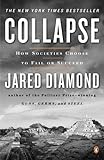
Jared Diamond's Collapse: How Societies Choose to Fail or Succeed
From time to time I will recommend books that are both interesting and can add to your social studies content knowledge. Collapse is one of these books. I personally found the book to be a fascinating account of the possible reasons for the collapse of societies. Read what Jennifer Buckendorff has to say about this book.
Jared Diamond's Collapse: How Societies Choose to Fail or Succeed is the glass-half-empty follow-up to his Pulitzer Prize-winning Guns, Germs, and Steel. While Guns, Germs, and Steel explained the geographic and environmental reasons why some human populations have flourished, Collapse uses the same factors to examine why ancient societies, including the Anasazi of the American Southwest and the Viking colonies of Greenland, as well as modern ones such as Rwanda, have fallen apart. Not every collapse has an environmental origin, but an eco-meltdown is often the main catalyst, he argues, particularly when combined with society's response to (or disregard for) the coming disaster. Still, right from the outset of Collapse, the author makes clear that this is not a mere environmentalist's diatribe. He begins by setting the book's main question in the small communities of present-day Montana as they face a decline in living standards and a depletion of natural resources. Once-vital mines now leak toxins into the soil, while prion diseases infect some deer and elk and older hydroelectric dams have become decrepit. On all these issues, and particularly with the hot-button topic of logging and wildfires, Diamond writes with equanimity.
Because he's addressing such significant issues within a vast span of time, Diamond can occasionally speak too briefly and assume too much, and at times his shorthand remarks may cause careful readers to raise an eyebrow. But in general, Diamond provides fine and well-reasoned historical examples, making the case that many times, economic and environmental concerns are one and the same. With Collapse, Diamond hopes to jog our collective memory to keep us from falling for false analogies or forgetting prior experiences, and thereby save us from potential devastations to come. While it might seem a stretch to use medieval Greenland and the Maya to convince a skeptic about the seriousness of global warming, it's exactly this type of cross-referencing that makes Collapse so compelling. --Jennifer Buckendorff
posted by Dr. Roger Passman @ 9:32 AM


0 Comments:
Post a Comment
<< Home